The Arctic polar vortex in the transition towards winters with greater variability in North America and Cuba
Article Sidebar
Main Article Content
Abstract
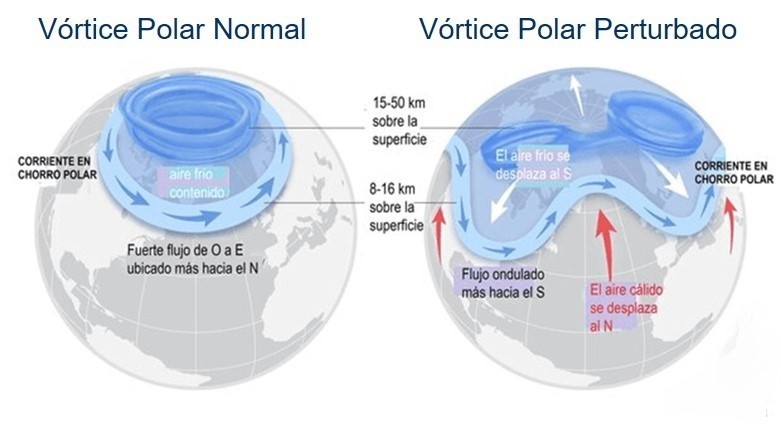
Studying the effects of global warming on atmospheric circulation is crucial for understanding changes in climate variability. This work aimed to explain the influence of the Arctic polar vortex (APV) on recent climate changes in Cuba, with an emphasis on winter cold air invasions associated with its disruption. A chronological analysis of major APV disruptions since 1977 was performed, and their synoptic and meteorotropic impacts on Cuba were evaluated using observational data, atmospheric reanalysis, and stratospheric-tropospheric teleconnection studies. The results showed a significant increase in the frequency of APV disruptions, especially after 2000, with eight events recorded between 2021 and 2025, including two complete collapses. These disturbances reorganized circulation patterns, increasing the frequency of meridional exchange mechanisms (Groups III and IV) that favor Arctic air incursions toward lower latitudes. In Cuba, this resulted in notable episodes of extreme cold, such as those of 1981, 1989, and 2010, with measurable impacts on agriculture and an increase in excess mortality, particularly pronounced in the western region of the country. It was concluded that the increasingly unstable stratospheric warming pattern (SWP), due to frequent sudden stratospheric warming events, is a determining factor in the transition to less stable winters, characterized by greater variability and a higher risk of extreme cold events within the long-term global warming trend.
Downloads
Article Details

This work is licensed under a Creative Commons Attribution-NonCommercial 4.0 International License.
Those authors who have publications with this journal accept the following terms of the License Attribution-NonCommercial 4.0 International (CC BY-NC 4.0):
You are free to:
- Share — copy and redistribute the material in any medium or format
- Adapt — remix, transform, and build upon the material
The licensor cannot revoke these freedoms as long as you follow the license terms.
Under the following terms:
- Attribution — You must give appropriate credit, provide a link to the license, and indicate if changes were made. You may do so in any reasonable manner, but not in any way that suggests the licensor endorses you or your use.
- NonCommercial — You may not use the material for commercial purposes.
- No additional restrictions — You may not apply legal terms or technological measures that legally restrict others from doing anything the license permits.
The journal is not responsible for the opinions and concepts expressed in the works, they are the sole responsibility of the authors. The Editor, with the assistance of the Editorial Committee, reserves the right to suggest or request advisable or necessary modifications. They are accepted to publish original scientific papers, research results of interest that have not been published or sent to another journal for the same purpose.
The mention of trademarks of equipment, instruments or specific materials is for identification purposes, and there is no promotional commitment in relation to them, neither by the authors nor by the publisher.
References
Baldwin, M. P. (2021). Stratospheric connections to regional weather: Review of the role of Sudden Stratospheric Warming (SSW). Nature Reviews Earth & Environment, 2(3), 159-173. https://doi.org/10.1038/s43017-021-00143-1.
Baldwin, M. P., Ayarzagüena, B., Birner, T., Butchart, N., Butler, A. H., Charlton-Perez, A. J. y otros (2019). 100 Years of progress in understanding the stratosphere and mesosphere. Meteorological Monographs, 59, 27.1-27.62. https://doi.org/10.1175/AMSMONOGRAPHS-D-19-0003.1
Baldwin, M. P., & Dunkerton, T. J. (2001). Stratospheric harbingers of anomalous weather regimes. Science, 294(5542), 581-584. https://doi.org/10.1126/science.1063315
Barcia, S., & Castillo, C. (2016). Condiciones de calor intenso en la provincia de Cienfuegos. Revista Cubana de Meteorología, 22(1), 26-38.
Butler, A. H. (2017). Sudden Stratospheric Warming and anomalous upward wave activity flux. Science Advances, 3(7). https://doi.org/10.1126/sciadv.1603028
Charlton‐Perez, A. J., Bröcker, J., Karpechko, A. Yu., Lee, S. H., Sigmond, M., & Simpson, I. R. (2021). A Minimal Model to Diagnose the Contribution of the Stratosphere to Tropospheric Forecast Skill. Journal of Geophysical Research: Atmospheres, 126(24), e2021JD035504. https://doi.org/10.1029/2021JD035504
Cohen, J., & Francis, J. (2022). Amplificación polar y su impacto en la dinámica atmosférica. https://sgkplanet.com/que-es-el-vortice-polar-y-que-sucedio-a-finales-de-2024-y-principios-de-2025/
Decker, S. (2024). Disrupciones del vórtice polar en un clima cambiante: ¿Nueva normalidad? https://sebsnjaesnews.rutgers.edu/2024/02/how-climate-change-may-be-affecting-the-polar-vortex/
Dzerdzeevskii, B. L. (1968). Los mecanismos de la circulación de la atmósfera en el hemisferio norte en el siglo XX. En Instituto Geográfico de la Academia de Ciencias de la URSS (Ed.), Resultados de Investigaciones durante el Año Geofísico Internacional. Circulación Atmosférica.
Francis, J. A., & Vavrus, S. J. (2012). Evidence linking Arctic amplification to extreme weather in mid-latitudes. Geophysical Research Letters, 39(6). https://doi.org/10.1029/2012GL051000
Goelzer, H., Nowicki, S., Edwards, T., Beckley, M., Abe-Ouchi, A., Aschwanden, A., & others. (2020). The future sea-level contribution of the Greenland ice sheet: A multi-model ensemble study of ISMIP6. The Cryosphere, 14(9), 3071-3096. https://doi.org/10.5194/tc-14-3071-2020
Horton, D. E., Johnson, N. C., Singh, D., Swain, D. L., Rajaratnam, B., & Diffenbaugh, N. S. (2015). Contribution of changes in atmospheric circulation patterns to extreme temperature trends. Nature, 522(7557), 465-469.
IPCC. (2022). Climate Change 2022: Impacts, adaptation and vulnerability. Summary for Policymakers (p. 32). WMO, UNEP.
Kidston, J., Scaife, A. A., Hardiman, S. C., Mitchell, D. M., Butchart, N., Baldwin, M. P., & others. (2015). Stratospheric influence on tropospheric jet streams, storm tracks and surface weather. Nature Geoscience, 8(6), 433-440. https://doi.org/10.1038/ngeo2424
Kim, B. M. (2014). Influencia de la pérdida de hielo marino en los mares de Barents-Kara en la estabilidad del vórtice polar. https://sgkplanet.com/que-es-el-vortice-polar-y-que-sucedio-a-finales-de-2024-y-principios-de-2025/
Kononova, N. K. (2010). Long-term fluctuations of the northern hemisphere atmospheric circulation, according to Dzerdzeevskii’s classification. Geography, Environment, Sustainability, 1(3), 25-43.
Kononova, N. K. (2016). Fluctuations of the Global Atmospheric Circulation in the XX-XXI Centuries. Journal of Earth Science & Climatic Change, 7(5), 350. https://doi.org/10.4172/2157-7617.1000350
Lecha, L. (2018). Biometeorological forecasts for health surveillance and prevention of meteor-tropic effects. International Journal of Biometeorology, 62(5), 741-771. https://doi.org/10.1007/s00484-017-1405-2
Lecha, L., García, D., & Carvajal, E. (2015). ¿Ocurren olas de calor en Cuba? Espacio y Geografía, 18(3), 517-541.
Lecha, L., Pichardo, L., Pena, E., & Guevara, A. (2024). Los extremos del régimen térmico y la mortalidad en exceso en Cuba. Revista Cubana de Meteorología, 30(2). https://cu-id.com/2377/v30n2e01
Lecha, L., Soler, E., Sánchez, L. M., & Verdecia, Y. (2024). La climatología sinópica de Cuba. Parte 2: El catálogo de los tipos de situaciones 1970-2022. Revista Cubana de Meteorología, 30(1).
Lecha, L., & Torres, S. (2025). Características e impacto de la ola de calor del verano de 2017 en Cuba. Revista Cubana de Meteorología, 31(1).
NOAA. (1982). Storm Data and Unusual Weather Phenomena (No. 23(1)). National Climatic Data Center.
NOAA. (2025). Final warming event of the 2024-2025 polar vortex season: Dynamics and implications. https://www.climate.gov/news-features/blogs/polar-vortex/early-interesting-end-2024-25-polar-vortex-season
NOTICIAS ONU. (2025). El enfriamiento de La Niña no detendrá el calentamiento global. https://news.un.org/es/story/2025/09/1540380
Overland, J. E., Dethloff, K., Francis, J. A., Hall, R. J., Hanna, E., Kim, S. J., & others. (2016). Nonlinear response of mid-latitude weather to the changing Arctic. Nature Climate Change, 6(11), 992-999. https://doi.org/10.1038/nclimate3121
Richter, J. H. (2022). Response of the Antarctic stratosphere to Artic perturbations in chemistry-climate models. Atmospheric Chemistry and Physics, 22(14), 9815-9833. https://doi.org/10.5194/acp-22-9815-2022
Screen, J. A., & Simmonds, I. (2013). Exploring links between Arctic amplification and mid-latitude weather. Geophysical Research Letters, 40(5), 959-964. https://doi.org/10.1002/grl.50174
Shaw, T. A., Baldwin, M., Barnes, E. A., Caballero, R., Garfinkel, C. I., Hwang, Y. T., & others. (2014). Storm track processes and the opposing influences of climate change. Nature Geoscience, 7(4), 270-275. https://doi.org/10.1038/ngeo2098
Soler, E., & Lecha, L. (2024). Efectos del calentamiento global sobre los procesos de la circulación atmosférica en el hemisferio norte durante el periodo 1899-2019. Revista Cubana de Meteorología, 30(4).
Soler, E., Lecha, L., & Roura, P. (2025). Comportamiento de los procesos regionales de la circulación que influyen sobre América del Norte desde finales del siglo XIX. Revista Cubana de Meteorología, 31(2).
Thompson, D. W. J., Solomon, S., Kushner, P. J., England, M. H., Grise, K. M., & Karoly, D. J. (2011). Signatures of the Antarctic ozone hole in Southern Hemisphere surface climate change. Nature Geoscience, 4(11), 741-749. https://doi.org/10.1038/ngeo1296
Trenberth, K. E. (2025). Oscilaciones del Pacífico como moduladores primarios de la variabilidad del vórtice polar: Análisis comparativo con forzantes árticos. https://www.climate.gov/news-features/blogs/polar-vortex/cold-air-its-probably-not-polar-vortex
trueno.es. (2025). Trueno: Sinfonías de la cultura joven. trueno.es. https://trueno.es/blog
Velázquez, B., Hernández, D., Barcia, S., Armas, O., & Guevara, V. (2022). Analysis of some properties of the intense cold conditions in Havana. Environmental Sciences Proceedings, 19(63). https://doi.org/10.3390/ecas2022-12825
Wang, L., Hardiman, S. C., Dunstone, N. J., Scaife, A. A., & Screen, J. A. (2019). Impacts of the autumn-winter Arctic sea ice on the stratospheric polar vortex. Geophysical Research Letters, 46(16), 10092-10100. https://doi.org/10.1029/2019GL083958