El vórtice polar Ártico en la transición hacia inviernos con mayor variabilidad en Norteamérica y Cuba
Barra lateral del artículo
Contenido principal del artículo
Resumen
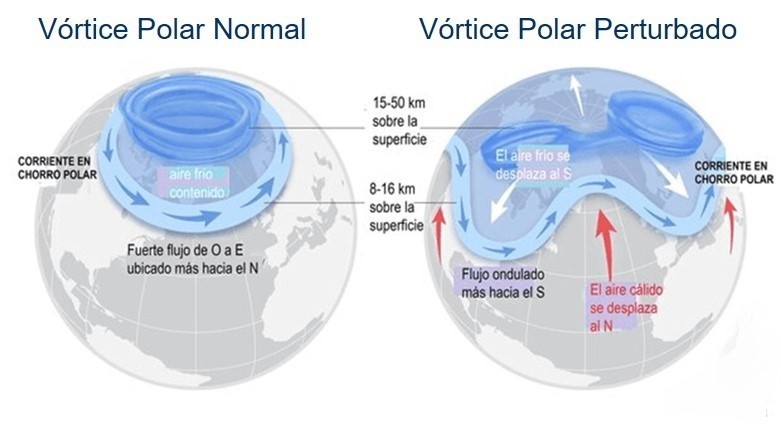
El estudio de los efectos del calentamiento global sobre la circulación atmosférica es crucial para comprender los cambios en la variabilidad climática. Este trabajo tuvo como objetivo explicar la influencia del comportamiento del vórtice polar ártico (VPA) en los cambios recientes del clima de Cuba, con énfasis en las invasiones frías invernales asociadas a su ruptura. Se realizó un análisis cronológico de las principales rupturas del VPA desde 1977 y se evaluaron sus impactos sinópticos y meteorotrópicos en Cuba, con datos de observación, reanálisis atmosférico y estudios de teleconexión estratosfera-troposfera. Los resultados mostraron un aumento significativo en la frecuencia de las rupturas del VPA, especialmente después del año 2000, con ocho eventos registrados entre 2021 y 2025, que incluyen dos colapsos totales. Estas perturbaciones reorganizaron los patrones de circulación, lo que incrementa la frecuencia de los mecanismos de intercambio meridionales (Grupos III y IV) que favorecen las irrupciones de aire ártico hacia latitudes bajas. En Cuba, esto se tradujo en episodios notables de frío extremo, como los de 1981, 1989 y 2010, con impactos medibles en la agricultura y un aumento de la mortalidad en exceso, particularmente sensible en la región occidental del país. Se concluyó que el VPA, cada vez más inestable debido a los calentamientos estratosféricos súbitos frecuentes, es un factor determinante en la transición hacia inviernos menos estables, caracterizados por una mayor variabilidad y un riesgo elevado de eventos fríos extremos insertos en la tendencia de calentamiento global a largo plazo.
Descargas
Detalles del artículo

Esta obra está bajo licencia internacional Creative Commons Reconocimiento-NoComercial 4.0.
Aquellos autores/as que tengan publicaciones con esta revista, aceptan los términos siguientes de la Licencia CC Reconocimiento-NoComercial 4.0 Internacional (CC BY-NC 4.0):
Usted es libre de:
- Compartir — copiar y redistribuir el material en cualquier medio o formato
- Adaptar — remezclar, transformar y crear a partir del material
El licenciador no puede revocar estas libertades mientras cumpla con los términos de la licencia.
Bajo las condiciones siguientes:
- Reconocimiento — Debe reconocer adecuadamente la autoría, proporcionar un enlace a la licencia e indicar si se han realizado cambios. Puede hacerlo de cualquier manera razonable, pero no de una manera que sugiera que tiene el apoyo del licenciador o lo recibe por el uso que hace.
- NoComercial — No puede utilizar el material para una finalidad comercial.
- No hay restricciones adicionales — No puede aplicar términos legales o medidas tecnológicas que legalmente restrinjan realizar aquello que la licencia permite.
La revista no se responsabiliza con las opiniones y conceptos emitidos en los trabajos, son de exclusiva responsabilidad de los autores. El Editor, con la asistencia del Comité de Editorial, se reserva el derecho de sugerir o solicitar modificaciones aconsejables o necesarias. Son aceptados para publicar trabajos científico originales, resultados de investigaciones de interés que no hayan sido publicados ni enviados a otra revista para ese mismo fin.
La mención de marcas comerciales de equipos, instrumentos o materiales específicos obedece a propósitos de identificación, no existiendo ningún compromiso promocional con relación a los mismos, ni por los autores ni por el editor.
Citas
Baldwin, M. P. (2021). Stratospheric connections to regional weather: Review of the role of Sudden Stratospheric Warming (SSW). Nature Reviews Earth & Environment, 2(3), 159-173. https://doi.org/10.1038/s43017-021-00143-1.
Baldwin, M. P., Ayarzagüena, B., Birner, T., Butchart, N., Butler, A. H., Charlton-Perez, A. J. y otros (2019). 100 Years of progress in understanding the stratosphere and mesosphere. Meteorological Monographs, 59, 27.1-27.62. https://doi.org/10.1175/AMSMONOGRAPHS-D-19-0003.1
Baldwin, M. P., & Dunkerton, T. J. (2001). Stratospheric harbingers of anomalous weather regimes. Science, 294(5542), 581-584. https://doi.org/10.1126/science.1063315
Barcia, S., & Castillo, C. (2016). Condiciones de calor intenso en la provincia de Cienfuegos. Revista Cubana de Meteorología, 22(1), 26-38.
Butler, A. H. (2017). Sudden Stratospheric Warming and anomalous upward wave activity flux. Science Advances, 3(7). https://doi.org/10.1126/sciadv.1603028
Charlton‐Perez, A. J., Bröcker, J., Karpechko, A. Yu., Lee, S. H., Sigmond, M., & Simpson, I. R. (2021). A Minimal Model to Diagnose the Contribution of the Stratosphere to Tropospheric Forecast Skill. Journal of Geophysical Research: Atmospheres, 126(24), e2021JD035504. https://doi.org/10.1029/2021JD035504
Cohen, J., & Francis, J. (2022). Amplificación polar y su impacto en la dinámica atmosférica. https://sgkplanet.com/que-es-el-vortice-polar-y-que-sucedio-a-finales-de-2024-y-principios-de-2025/
Decker, S. (2024). Disrupciones del vórtice polar en un clima cambiante: ¿Nueva normalidad? https://sebsnjaesnews.rutgers.edu/2024/02/how-climate-change-may-be-affecting-the-polar-vortex/
Dzerdzeevskii, B. L. (1968). Los mecanismos de la circulación de la atmósfera en el hemisferio norte en el siglo XX. En Instituto Geográfico de la Academia de Ciencias de la URSS (Ed.), Resultados de Investigaciones durante el Año Geofísico Internacional. Circulación Atmosférica.
Francis, J. A., & Vavrus, S. J. (2012). Evidence linking Arctic amplification to extreme weather in mid-latitudes. Geophysical Research Letters, 39(6). https://doi.org/10.1029/2012GL051000
Goelzer, H., Nowicki, S., Edwards, T., Beckley, M., Abe-Ouchi, A., Aschwanden, A., & others. (2020). The future sea-level contribution of the Greenland ice sheet: A multi-model ensemble study of ISMIP6. The Cryosphere, 14(9), 3071-3096. https://doi.org/10.5194/tc-14-3071-2020
Horton, D. E., Johnson, N. C., Singh, D., Swain, D. L., Rajaratnam, B., & Diffenbaugh, N. S. (2015). Contribution of changes in atmospheric circulation patterns to extreme temperature trends. Nature, 522(7557), 465-469.
IPCC. (2022). Climate Change 2022: Impacts, adaptation and vulnerability. Summary for Policymakers (p. 32). WMO, UNEP.
Kidston, J., Scaife, A. A., Hardiman, S. C., Mitchell, D. M., Butchart, N., Baldwin, M. P., & others. (2015). Stratospheric influence on tropospheric jet streams, storm tracks and surface weather. Nature Geoscience, 8(6), 433-440. https://doi.org/10.1038/ngeo2424
Kim, B. M. (2014). Influencia de la pérdida de hielo marino en los mares de Barents-Kara en la estabilidad del vórtice polar. https://sgkplanet.com/que-es-el-vortice-polar-y-que-sucedio-a-finales-de-2024-y-principios-de-2025/
Kononova, N. K. (2010). Long-term fluctuations of the northern hemisphere atmospheric circulation, according to Dzerdzeevskii’s classification. Geography, Environment, Sustainability, 1(3), 25-43.
Kononova, N. K. (2016). Fluctuations of the Global Atmospheric Circulation in the XX-XXI Centuries. Journal of Earth Science & Climatic Change, 7(5), 350. https://doi.org/10.4172/2157-7617.1000350
Lecha, L. (2018). Biometeorological forecasts for health surveillance and prevention of meteor-tropic effects. International Journal of Biometeorology, 62(5), 741-771. https://doi.org/10.1007/s00484-017-1405-2
Lecha, L., García, D., & Carvajal, E. (2015). ¿Ocurren olas de calor en Cuba? Espacio y Geografía, 18(3), 517-541.
Lecha, L., Pichardo, L., Pena, E., & Guevara, A. (2024). Los extremos del régimen térmico y la mortalidad en exceso en Cuba. Revista Cubana de Meteorología, 30(2). https://cu-id.com/2377/v30n2e01
Lecha, L., Soler, E., Sánchez, L. M., & Verdecia, Y. (2024). La climatología sinópica de Cuba. Parte 2: El catálogo de los tipos de situaciones 1970-2022. Revista Cubana de Meteorología, 30(1).
Lecha, L., & Torres, S. (2025). Características e impacto de la ola de calor del verano de 2017 en Cuba. Revista Cubana de Meteorología, 31(1).
NOAA. (1982). Storm Data and Unusual Weather Phenomena (No. 23(1)). National Climatic Data Center.
NOAA. (2025). Final warming event of the 2024-2025 polar vortex season: Dynamics and implications. https://www.climate.gov/news-features/blogs/polar-vortex/early-interesting-end-2024-25-polar-vortex-season
NOTICIAS ONU. (2025). El enfriamiento de La Niña no detendrá el calentamiento global. https://news.un.org/es/story/2025/09/1540380
Overland, J. E., Dethloff, K., Francis, J. A., Hall, R. J., Hanna, E., Kim, S. J., & others. (2016). Nonlinear response of mid-latitude weather to the changing Arctic. Nature Climate Change, 6(11), 992-999. https://doi.org/10.1038/nclimate3121
Richter, J. H. (2022). Response of the Antarctic stratosphere to Artic perturbations in chemistry-climate models. Atmospheric Chemistry and Physics, 22(14), 9815-9833. https://doi.org/10.5194/acp-22-9815-2022
Screen, J. A., & Simmonds, I. (2013). Exploring links between Arctic amplification and mid-latitude weather. Geophysical Research Letters, 40(5), 959-964. https://doi.org/10.1002/grl.50174
Shaw, T. A., Baldwin, M., Barnes, E. A., Caballero, R., Garfinkel, C. I., Hwang, Y. T., & others. (2014). Storm track processes and the opposing influences of climate change. Nature Geoscience, 7(4), 270-275. https://doi.org/10.1038/ngeo2098
Soler, E., & Lecha, L. (2024). Efectos del calentamiento global sobre los procesos de la circulación atmosférica en el hemisferio norte durante el periodo 1899-2019. Revista Cubana de Meteorología, 30(4).
Soler, E., Lecha, L., & Roura, P. (2025). Comportamiento de los procesos regionales de la circulación que influyen sobre América del Norte desde finales del siglo XIX. Revista Cubana de Meteorología, 31(2).
Thompson, D. W. J., Solomon, S., Kushner, P. J., England, M. H., Grise, K. M., & Karoly, D. J. (2011). Signatures of the Antarctic ozone hole in Southern Hemisphere surface climate change. Nature Geoscience, 4(11), 741-749. https://doi.org/10.1038/ngeo1296
Trenberth, K. E. (2025). Oscilaciones del Pacífico como moduladores primarios de la variabilidad del vórtice polar: Análisis comparativo con forzantes árticos. https://www.climate.gov/news-features/blogs/polar-vortex/cold-air-its-probably-not-polar-vortex
trueno.es. (2025). Trueno: Sinfonías de la cultura joven. trueno.es. https://trueno.es/blog
Velázquez, B., Hernández, D., Barcia, S., Armas, O., & Guevara, V. (2022). Analysis of some properties of the intense cold conditions in Havana. Environmental Sciences Proceedings, 19(63). https://doi.org/10.3390/ecas2022-12825
Wang, L., Hardiman, S. C., Dunstone, N. J., Scaife, A. A., & Screen, J. A. (2019). Impacts of the autumn-winter Arctic sea ice on the stratospheric polar vortex. Geophysical Research Letters, 46(16), 10092-10100. https://doi.org/10.1029/2019GL083958