Interactive atlas for visualizing climate change scenarios in Cuba
Article Sidebar
Main Article Content
Abstract
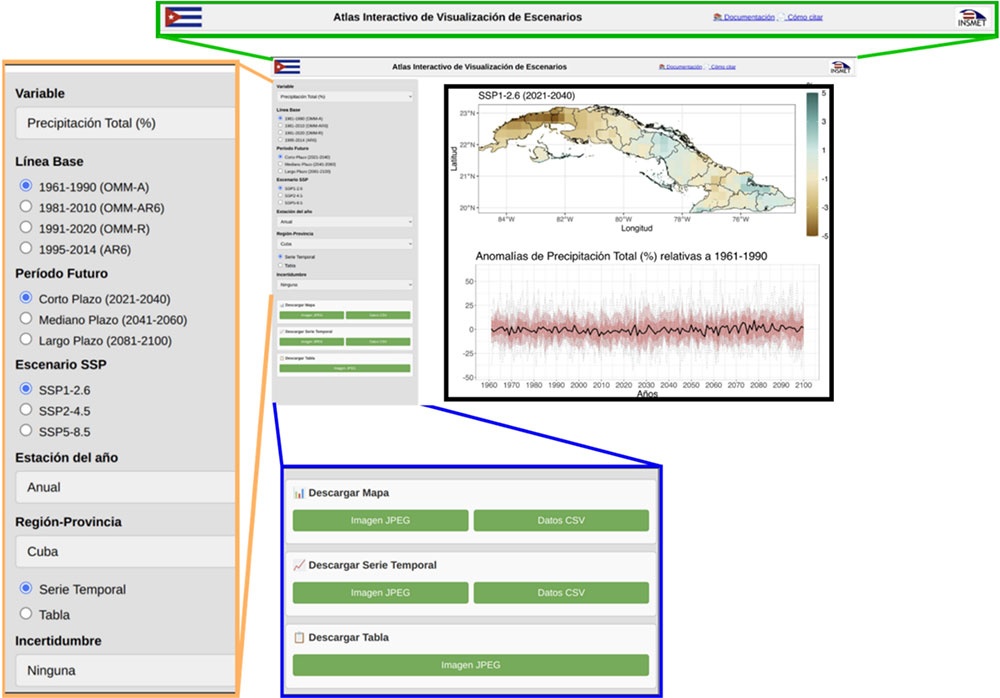
This article presents the "Interactive Atlas for Visualizing Climate Change Scenarios in Cuba", a tool developed to facilitate access to and analysis of climate projections at national and provincial levels. To maximize accessibility, the tool was implemented in two modalities: a web application and a cross-platform desktop application (Windows/Linux). Built within the RStudio environment by integrating R and Python functionalities, it enables users to generate customizable maps, graphs, and tables by selecting from various options, including climate variables, emission scenarios, future time periods, and regions of interest. The Atlas represents a valuable resource for meeting Cuba's growing demand for projected climate information. It supports key sectors, institutions, and stakeholders in conducting impact assessments, thereby aligning with the objectives and commitments outlined in the State Plan to Confront Climate Change, known as Tarea Vida.
Downloads
Article Details

This work is licensed under a Creative Commons Attribution-NonCommercial 4.0 International License.
Those authors who have publications with this journal accept the following terms of the License Attribution-NonCommercial 4.0 International (CC BY-NC 4.0):
You are free to:
- Share — copy and redistribute the material in any medium or format
- Adapt — remix, transform, and build upon the material
The licensor cannot revoke these freedoms as long as you follow the license terms.
Under the following terms:
- Attribution — You must give appropriate credit, provide a link to the license, and indicate if changes were made. You may do so in any reasonable manner, but not in any way that suggests the licensor endorses you or your use.
- NonCommercial — You may not use the material for commercial purposes.
- No additional restrictions — You may not apply legal terms or technological measures that legally restrict others from doing anything the license permits.
The journal is not responsible for the opinions and concepts expressed in the works, they are the sole responsibility of the authors. The Editor, with the assistance of the Editorial Committee, reserves the right to suggest or request advisable or necessary modifications. They are accepted to publish original scientific papers, research results of interest that have not been published or sent to another journal for the same purpose.
The mention of trademarks of equipment, instruments or specific materials is for identification purposes, and there is no promotional commitment in relation to them, neither by the authors nor by the publisher.
References
Centella, A & Bezanilla, A. 2013. “Escenarios climáticos” In Planos E., R. Rivero y A. Guevara (eds.) “Impacto del cambio climático y medidas de adaptación en Cuba”.Ed. AMA, 430 pp. Instituto de Meteorología, Agencia de Medio Ambiente, Ministerio de Ciencia, Tecnología y Medio Ambiente, La Habana, Cuba.
Centella, A; Bezanilla, A.; Fuentes, A.; Vázquez, R.; Guevara, V.; Velázquez, B.; Roque, A.; & Gutiérrez, T. 2025. “Perfiles de cambio climático para Cuba y atlas interactivo de escenarios climáticos.”, Instituto de Meteorología, Informe de Resultado Científico, La Habana, 72 pp
Gutiérrez, T.; Centella, A.; Limia, M. & López, M. 1999. “Impactos del Cambio Climático y Medidas de Adaptación en Cuba”. Instituto de Meteorología, Informe Final del Proyecto No. 01301-019. La Habana, 181 pp
Pérez-Parrado, R. 2019. Ascenso del nivel del mar en Cuba por Cambio Climático. Revista Cubana de Meteorología. 25, 1 (feb. 2019), 76-83.
Planos, E.; Rivero, R. E.; & Guevara, V (eds.) 2013. “Impacto del cambio climático y medidas de adaptación en Cuba”, Ed. AMA, 430 pp. Instituto de Meteorología, Agencia de Medio Ambiente, Ministerio de Ciencia, Tecnología y Medio Ambiente, La Habana, Cuba.
Thrasher, B.; Wang, W.; Michaelis, A.; Melton, F.; Lee, T.; & Nemani, R. 2022. “NASA Global Daily Downscaled Projections, CMIP6”. Scientific Data, 9(1). https://doi.org/10.1038/s41597-022-01393-4
WMO. 2017. “WMO Guidelines on the Calculation of Climate Normals”. WMO-No. 1203, World Meteorological Organization (WMO), Geneva, Switzerland,18 pp., https://library.wmo.int/doc_num.php?explnum_id=4166.