Greenhouse gas emissions from wastewater treatment
Article Sidebar
Main Article Content
Abstract
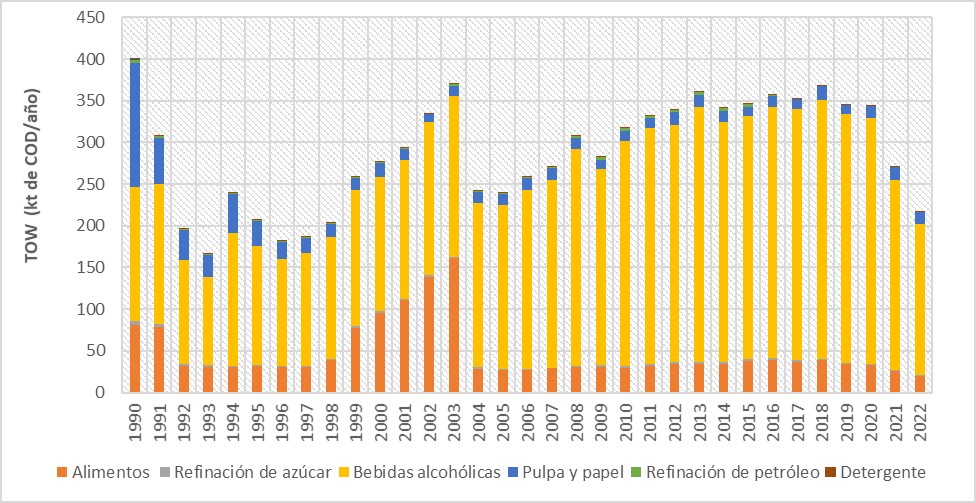
Quantifying greenhouse gas (GHG) emissions from wastewater treatment is fundamental for national inventories and climate change mitigation. This study aimed to estimate these emissions for domestic and industrial wastewater in Cuba during the period 1990–2022. The methodology followed the IPCC Level 1 Guidelines (2006), using default emission factors. Methane (CH₄) emissions were calculated from the organic load (expressed as BOD for domestic wastewater and COD for industrial wastewater) and the fractions of wastewater directed to different treatment or disposal systems (anaerobic lagoons, septic tanks, direct discharge into water bodies, among others). Indirect nitrous oxide (N₂O) emissions were estimated based on human protein consumption for effluents discharged into aquatic environments. The results showed that total emissions in 2022 were 1936.59 kt of CO₂-eq, representing a 1.31% increase compared to 1990. A decrease in industrial emissions was observed due to the sector's limited development, but an increase in domestic emissions and N₂O emissions was associated with greater sanitation coverage and wastewater disposal. It was concluded that CH₄ was the predominant GHG and that, while Cuban emissions are lower than global averages, it is necessary to promote more efficient, low-emission treatment systems to contribute to climate mitigation.
Downloads
Article Details

This work is licensed under a Creative Commons Attribution-NonCommercial 4.0 International License.
Those authors who have publications with this journal accept the following terms of the License Attribution-NonCommercial 4.0 International (CC BY-NC 4.0):
You are free to:
- Share — copy and redistribute the material in any medium or format
- Adapt — remix, transform, and build upon the material
The licensor cannot revoke these freedoms as long as you follow the license terms.
Under the following terms:
- Attribution — You must give appropriate credit, provide a link to the license, and indicate if changes were made. You may do so in any reasonable manner, but not in any way that suggests the licensor endorses you or your use.
- NonCommercial — You may not use the material for commercial purposes.
- No additional restrictions — You may not apply legal terms or technological measures that legally restrict others from doing anything the license permits.
The journal is not responsible for the opinions and concepts expressed in the works, they are the sole responsibility of the authors. The Editor, with the assistance of the Editorial Committee, reserves the right to suggest or request advisable or necessary modifications. They are accepted to publish original scientific papers, research results of interest that have not been published or sent to another journal for the same purpose.
The mention of trademarks of equipment, instruments or specific materials is for identification purposes, and there is no promotional commitment in relation to them, neither by the authors nor by the publisher.
References
OMM. (2020). Boletín de la Organización Meteorológica Mundial sobre los gases de efecto invernadero. http://library.wmo.int/index.php?lvl=notice_display&id=21819
ONEI. (2023). Anuario Estadístico 2022. Oficina Nacional de Estadísticas e Información. http://www.onei.gob.cu
ONN. (2007). Norma Cubana NC 521:2007. Vertimiento de aguas residuales a la zona costera y aguas marinas. Oficina Nacional de Normalización (ONN).
ONN. (2012). Norma Cubana NC 27:2012. Vertimiento de aguas residuales a las aguas terrestres y al alcantarillado. Oficina Nacional de Normalización.
Pachauri, R. K., & Meyer, L. A. (Eds.). (2014). Climate Change 2014: Synthesis Report. Contribution of Working Groups I, II and III to the Fifth Assessment Report of the Intergovernmental Panel on Climate Change. IPCC.
Pipatti, R., Svardal, P., Silvana, J. W., Gao, Q., López, C., Mareckova, K., Oonk, H., Scheehle, E., Sharma, C., Smith, A., Yamada, M., Sabin, G. H., Koch, M., Svardal, P., & Manso, S. M. (Eds.). (2006). Guidelines for National Greenhouse Gas Inventories. Volume 5: Waste. Institute for Global Environmental Strategies (IGES).
República de Cuba. (2020). Tercera Comunicación Nacional a la Convención Marco de las Naciones Unidas sobre Cambio Climático. Ministerio de Ciencia, Tecnología y Medio Ambiente.
FAOSTAT (2021). “Food and Agriculture Organization of the United Nations. Avarage protein supply. 2021”. URL: https://www.fao.org/faostat/en/#country/49