Life cycle and climate risk in tourist destinations: Jardines del Rey case study
Article Sidebar
Main Article Content
Abstract
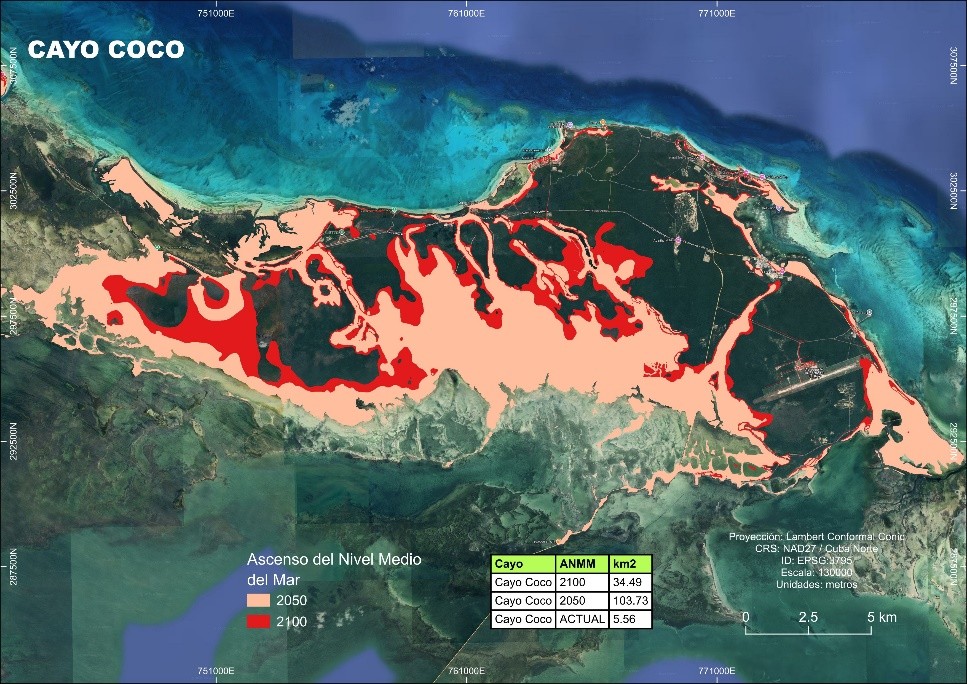
Integrating climate risk into tourism planning is crucial for the sustainability of vulnerable coastal destinations. This study aimed to assess climate risk in the Jardines del Rey destination (Cuba) by updating its life cycle model with climate variables. A descriptive-correlational methodology was employed, using documentary and cartographic analysis, expert interviews, and empirical observation on the keys of Coco, Guillermo, and Paredón Grande. The independent variables analyzed were mean sea level rise (projections 2050/2100), hurricane exposure, ecological sensitivity, and coastal erosion. The results revealed that the growth of hotel infrastructure (6.6% annually) outpaced demand growth (3.9%), calling into question the previously assigned "consolidation" phase. It was projected that by 2100, more than 50% of the surface area of Cayo Guillermo and Cayo Paredón Grande would suffer permanent flooding, classifying the climate risk as very high due to their geomorphological fragility and high development density. It was concluded that the classic life cycle model is insufficient and must be updated by integrating climate projections to prioritize progressive adaptation measures, redirect investments, and strengthen the resilience of the destination, discouraging expansion in high-risk areas.
Downloads
Article Details

This work is licensed under a Creative Commons Attribution-NonCommercial 4.0 International License.
Those authors who have publications with this journal accept the following terms of the License Attribution-NonCommercial 4.0 International (CC BY-NC 4.0):
You are free to:
- Share — copy and redistribute the material in any medium or format
- Adapt — remix, transform, and build upon the material
The licensor cannot revoke these freedoms as long as you follow the license terms.
Under the following terms:
- Attribution — You must give appropriate credit, provide a link to the license, and indicate if changes were made. You may do so in any reasonable manner, but not in any way that suggests the licensor endorses you or your use.
- NonCommercial — You may not use the material for commercial purposes.
- No additional restrictions — You may not apply legal terms or technological measures that legally restrict others from doing anything the license permits.
The journal is not responsible for the opinions and concepts expressed in the works, they are the sole responsibility of the authors. The Editor, with the assistance of the Editorial Committee, reserves the right to suggest or request advisable or necessary modifications. They are accepted to publish original scientific papers, research results of interest that have not been published or sent to another journal for the same purpose.
The mention of trademarks of equipment, instruments or specific materials is for identification purposes, and there is no promotional commitment in relation to them, neither by the authors nor by the publisher.
References
Butler, R. W. (2006). Time path analysis and TALC stage demarcation. En S. Lundtorp & S. Wanhill (Eds.), The tourism area life cycle (TALC): Vol. 2. Conceptual and theoretical issues (pp. 141-155). Channel View Publications. http://www.channelviewpublications.com
Butler, R. W. (2018). Challenges and opportunities. Worldwide Hospitality and Tourism Themes, 10(6), 635-641. https://doi.org/10.1108/WHATT-07-2018-0042
Butler, R. W. (2025). Tourism destination development: The tourism area life cycle model. Tourism Geographies, 27(3–4), 599-607. https://doi.org/10.1080/14616688.2024.2325932
CITMA. (2020). Tercera comunicación nacional a la Convención Marco de Naciones Unidas sobre Cambio Climático. Sello Editorial AMA. Ministerio de Ciencia, Tecnología y Medio Ambiente (CITMA).
CITMA. (2021). Resolución 252 sobre el Catálogo de Playas Cubanas: Línea base de las playas (Resolución No. GOC-2021-1128-0144). Gaceta Oficial de la República de Cuba No. 144. Ministerio de Ciencia, Tecnología y Medio Ambiente. https://www.gacetaoficial.gob.cu
CITMA. (2023). Resumen de los resultados del macroproyecto: Escenarios de peligro y vulnerabilidad de la zona costera cubana, asociados al ascenso del nivel medio del mar para los años 2050 y 2100 (Versión 15, 2022). Ministerio de Ciencia, Tecnología y Medio Ambiente.
Cuesta Flores, A., Dávila Sotolongo, I., Báez Peña, L., Martínez Cárdenas, C. V., & Veiga Jiménez, E. (2011). Alerta y monitoreo del ciclo de vida del destino Jardines del Rey. Escuela de Hotelería y Turismo de Ciego de Ávila; FORMATUR.
Diez, V. A. (2019). El modelo de ciclo de vida de los destinos turísticos: Vigencia, críticas y adaptaciones al modelo Butler. Realidad, Tendencias y Desafíos en Turismo, 17(1), 19-34.
ETS. (2024). Hablemos de turismo: La OMT se convierte en ONU Turismo. Entorno Turístico Staff; Entorno Turístico. https://www.entornoturistico.com/
INSMET. (2006). Impacto de la surgencia en el archipiélago cubano, considerando los cambios climáticos. Instituto de Meteorología; Agencia de Medio Ambiente del Ministerio de Ciencia, Tecnología y Medio Ambiente.
IPF. (2014). Resumen ejecutivo archipiélago Sabana–Camagüey: Estudio regional de la cayería norte de Cuba desde Villa Clara hasta Camagüey. Instituto de Planificación Física.
Korstanje, M. E. (2020). Turismo, riesgo y cambio climático: Un camino alternativo. Estudios y Perspectivas en Turismo, 29(1), 214-227.
Remond-Noa, R., Torres-Reyes, A., Matos-Pupo, F., Echarri-Chávez, M., Bouta-Numbo, A., Crespo-García, L., & Gómez-Martín, M. B. (2024). The location of hotels and their exposure to hurricanes in Cuba: Implications for tourism development in the context of climate change. Atmosphere, 16(1), 24. https://doi.org/10.3390/atmos16010024
Rodrigo, M., Ajala, I., & Irhanida, A. K. (2023). Qualitative analysis of a tourism area life cycle model for interacting tourism destinations. Annals of Tourism Research Empirical Insights, 4(1), 100093. https://doi.org/10.1016/j.annale.2023.100093
Scott, D., & Gössling, S. (2022). A review of tourism and climate change mitigation: The scales, scopes, stakeholders and strategies of carbon management. Tourism Management, 104, 104441. https://doi.org/10.1016/j.tourman.2022.104441