Meteorological analysis and air pollution in distributed power generation scenarios in Santiago de Cuba
Article Sidebar
Main Article Content
Abstract
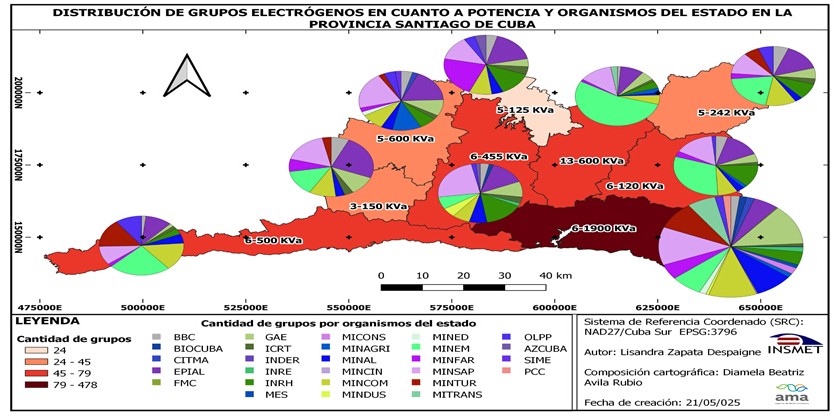
Assessing the environmental impact of distributed electricity generation in urban areas is crucial for public health and air quality management. This study aimed to analyze the relationship between meteorological variables and the distribution of emergency generator sets (EGS) to evaluate their environmental impact in Santiago de Cuba. Historical data series (1991–2020) of temperature, relative humidity, wind speed, and precipitation from three meteorological stations were processed using the SAROM system. The provincial electric company's database was analyzed to georeference 872 EGS using QGIS. The results showed a sustained increase in the average annual temperature (up to 1.6 °C) and a trend toward reduced wind speed in urban areas, conditions that limit the dispersion of pollutants. The distribution of EGS was highly uneven, with 55% concentrated in the capital city, and brands such as DENYO predominating. It was concluded that the operation of these groups, in a context of local warming and meteorological conditions that favor atmospheric stability, exacerbates the accumulation of emissions and increases the risk to the respiratory health of the urban population.
Downloads
Article Details

This work is licensed under a Creative Commons Attribution-NonCommercial 4.0 International License.
Those authors who have publications with this journal accept the following terms of the License Attribution-NonCommercial 4.0 International (CC BY-NC 4.0):
You are free to:
- Share — copy and redistribute the material in any medium or format
- Adapt — remix, transform, and build upon the material
The licensor cannot revoke these freedoms as long as you follow the license terms.
Under the following terms:
- Attribution — You must give appropriate credit, provide a link to the license, and indicate if changes were made. You may do so in any reasonable manner, but not in any way that suggests the licensor endorses you or your use.
- NonCommercial — You may not use the material for commercial purposes.
- No additional restrictions — You may not apply legal terms or technological measures that legally restrict others from doing anything the license permits.
The journal is not responsible for the opinions and concepts expressed in the works, they are the sole responsibility of the authors. The Editor, with the assistance of the Editorial Committee, reserves the right to suggest or request advisable or necessary modifications. They are accepted to publish original scientific papers, research results of interest that have not been published or sent to another journal for the same purpose.
The mention of trademarks of equipment, instruments or specific materials is for identification purposes, and there is no promotional commitment in relation to them, neither by the authors nor by the publisher.
References
Carbonell, L. M. T. (2014). Modelación de la contaminación atmosférica y valoración de impactos epidemiológicos y externalidades, asociadas a instalaciones energéticas e industriales [PhD Thesis]. En Anales de la Academia de Ciencias de Cuba. Academia de Ciencias de Cuba.
Cuesta-Santos, O., Sosa-Pérez, C., & Fonte-Hernández, A. (2015). Impacto de las emisiones industriales en la salud pública en Santiago de Cuba. Revista Ciencias Técnicas Agropecuarias, 24(3), 45-52.
Cuesta-Santos, O., Sosa-Pérez, C., & Fonte-Hernández, A. (2018). Inventario nacional de emisiones atmosféricas de las principales fuentes fijas. Revista Cubana de Meteorología, 24(2), 178-190.
Cuesta-Santos, O., Sosa-Pérez, C., Iraola-Ramírez, C., & González-Jaime, Y. (2014). Evaluación de la calidad del aire en zonas urbanas de Santiago de Cuba [Technical Report]. Instituto de Meteorología, Cuba.
Hourné-Calzada, M. B., Brito-Vallina, M. L., del Castillo-Serpa, A. M., Fraga-Guerra, E., & Díaz-Concepción, A. (2012). Análisis de criticidad de grupos electrógenos de la tecnología fuel oil en Cuba. Revista Ciencias Técnicas Agropecuarias, 21(3), 55-61.
IPCC. (2021). Climate Change 2021: The Physical Science Basis (Intergovernmental Panel on Climate Change). Cambridge University Press.
Marrero Díaz, Y., Cruz Estopiñán, E. B., & Reyes Mesa, A. (2020). Evaluación de las emisiones atmosféricas provenientes de grupos electrógenos en la provincia de Holguín, Cuba. Revista Cubana de Meteorología, 26(4).
PNUMA. (2004). Evaluación ambiental de Santiago de Cuba (Programa de las Naciones Unidas para el Medio Ambiente) [Report]. PNUMA.
PNUMA. (2009). Informe de seguimiento ambiental en Santiago de Cuba (Programa de las Naciones Unidas para el Medio Ambiente) [Report]. PNUMA.
Seinfeld, J. H., & Pandis, S. N. (2016). Atmospheric Chemistry and Physics: From Air Pollution to Climate Change (3.a ed.). Wiley.
UNEP. (2019). Air Pollution in Asia and the Pacific: Science-based Solutions. United Nations Environment Programme.
Varona, M., Arocha, A., Esquivel, E., & Roche, R. (2007). Grupos electrógenos y su impacto ambiental. Higiene y Sanidad Ambiental, 9(7), 217-221.
WHO. (2021). WHO Global Air Quality Guidelines: Particulate Matter (PM2.5 and PM10), Ozone, Nitrogen Dioxide, Sulfur Dioxide and Carbon Monoxide. World Health Organization.