Analysis of tropical cyclone trajectories in the Gulf of Mexico
Article Sidebar
Main Article Content
Abstract
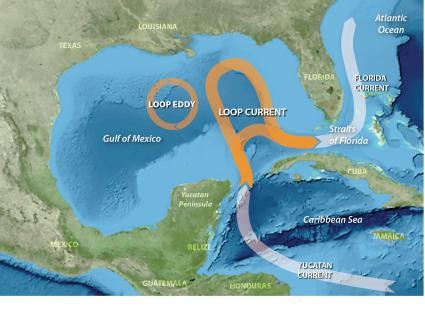
The trajectories of tropical cyclones that moved through the Gulf of Mexico during the period 2000-2022 were analyzed using statistical methods. A discrimination of the trajectories was performed, based on the formation region of these events, evaluating the specific influence of the Loop Current on their translation. The data were obtained from the Atlantic tropical cyclone database, HURDAT2. A clear influence of the Loop Current was found on the direction of the trajectory of tropical cyclones that impact the Gulf region. Those systems that interact intensely with this current tend to follow more northern trajectories or deviate to the east, while others may maintain a trajectory to the west, impacting the Mexican coasts.
Downloads
Article Details

This work is licensed under a Creative Commons Attribution-NonCommercial 4.0 International License.
Those authors who have publications with this journal accept the following terms of the License Attribution-NonCommercial 4.0 International (CC BY-NC 4.0):
You are free to:
- Share — copy and redistribute the material in any medium or format
- Adapt — remix, transform, and build upon the material
The licensor cannot revoke these freedoms as long as you follow the license terms.
Under the following terms:
- Attribution — You must give appropriate credit, provide a link to the license, and indicate if changes were made. You may do so in any reasonable manner, but not in any way that suggests the licensor endorses you or your use.
- NonCommercial — You may not use the material for commercial purposes.
- No additional restrictions — You may not apply legal terms or technological measures that legally restrict others from doing anything the license permits.
The journal is not responsible for the opinions and concepts expressed in the works, they are the sole responsibility of the authors. The Editor, with the assistance of the Editorial Committee, reserves the right to suggest or request advisable or necessary modifications. They are accepted to publish original scientific papers, research results of interest that have not been published or sent to another journal for the same purpose.
The mention of trademarks of equipment, instruments or specific materials is for identification purposes, and there is no promotional commitment in relation to them, neither by the authors nor by the publisher.
References
IPCC 2021. Climate Change 2021. The Physical Science Basis. Working Group I Contribution to the Sixth Assessment Report of the Intergovernmental Panel on Climate Change. Cambridge, United Kingdom and New York, USA: Cambridge University Press, 2391 p., Available:
Jewson, S. 2023. “Tropical Cyclones and Climate Change Global Landfall Frequency Projections Derived from Knutson et al.”. Bulletin of American Meteorological Society, 104(5): E1085–E1104, DOI: 10.1175/BAMS-D-22-0189.2.
Knutson, T.; Camargo, S. J.; Chan, J. C. L.; Emanuel, K.; Ho, C.-H.; Kossin, J.; Mohapatra, M.; Satoh, M.; Sugi, M.; Walsh, K. & Wu, L. 2020. “Tropical Cyclones and Climate Change Assessment: Part II: Projected Response to Anthropogenic Warming”. Bulletin of the American Meteorological Society, 101(3): E303–E322, DOI: 10.1175/BAMS-D-18-0194.1.
Kourafalou, V.; Androulidakis, Y.; Le Hénaff, M. & Kang, H. 2017. “The Dynamics of Cuba Anticyclones (CubANs) and Interaction With the Loop Current/Florida Current System”. Journal of Geophysical Research: Oceans, 122(10): 7897–7923, ISSN: 2169-9275, 2169-9291, DOI: 10.1002/2017JC012928.
Landsea, C.; Franklin, J. & Beven, J. 2015. The revised Atlantic hurricane database (HURDAT2). National Hurricane Center, Available:
Maul, G. A. & Herman, A. 1985. “Mean dynamic topography of the Gulf of Mexico with application to satellite altimetry”. Marine Geodesy, 9: 27–44.
Mitrani, I.; Cabrales, J.; Vichot, A. & Hidalgo, A. 2024. “Estructura termohalina en la corriente de lazo, al paso de huracanes que afectaron Cuba en 2002-2022”. Revista Cubana de Meteorología, 30(Especial): 1–11, DOI: https://cu-id.com/2377/v30nspe09.
Mitrani, I. & Díaz, O. O. 2008. “Particularidades de la estructura termohalina y sus tendencias en aguas cubanas”. Revista Cubana de Meteorología, 14(1): 54–73.
NHC. 2025. National Hurricane Center Archive. Available:
OMM 2012. Actualización de la escala Saffir-Simpson según la intensidad de sus vientos máximos sostenidos medidos en un minuto. (no. ser. OMM/DT No. 494), Ginebra: Organización Meteorológica Mundial.
Rudzin, J. E.; Shay, L. K. & Jaimes De La Cruz, B. 2019. “The Impact of the Amazon–Orinoco River Plume on Enthalpy Flux and Air–Sea Interaction within Caribbean Sea Tropical Cyclones”. Monthly Weather Review, 147(3): 931–950, ISSN: 0027-0644, 1520-0493, DOI: 10.1175/MWR-D-18-0295.1.
Valderá, N.; Marcelo, G. & Victorero, A. 2024. “Los ciclones tropicales del Golfo de México y su relación con la corriente de Lazo”. Revista Cubana de Meteorología, 30(1): 1–10, DOI: https://cu-id.com/2377/v30n1e05.