Characterization of temperature and precipitation in Guamá, Santiago de Cuba: Successive approximations
Article Sidebar
Main Article Content
Abstract
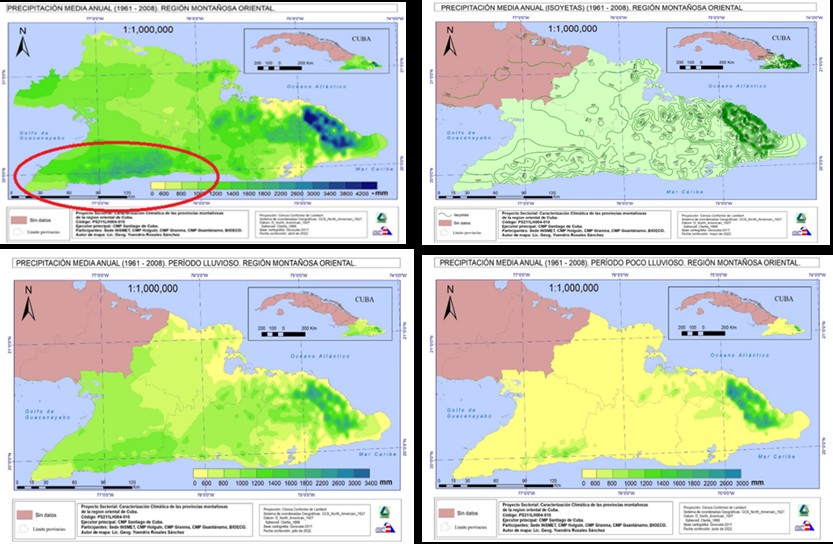
Understanding climate in heterogeneous regions is fundamental for socioeconomic planning and adaptation to climate variability. This study aimed to characterize temperature and precipitation variables in the coastal and mountain ecosystems of the municipality of Guamá, Santiago de Cuba, analyzing their behavior during the rainy (PL1) and dry (PPL1) seasons. Analytical-comparative methods and geographic information systems (QGIS) were used, processing temperature data series (1992–2010) from 18 meteorological stations and precipitation data series (1961–2008) from the national rainfall network. The results showed marked differences: average temperatures were higher on the coast (23.1°C–32°C) than in the mountains (13°C–24°C), with a clear altitudinal gradient, and the highest values were recorded during the PL1. Rainfall showed an opposite pattern, being significantly more abundant in mountainous areas (1600–3000 mm annually) than in coastal areas (600–1200 mm), especially during the first 10 months of the year. It was concluded that Guamá's climate is warm and tropical with a rainy season in the summer, determined by the interaction of altitude, maritime influence, and seasonality, which generates distinct microclimates with implications for activities such as agriculture.
Downloads
Article Details

This work is licensed under a Creative Commons Attribution-NonCommercial 4.0 International License.
Those authors who have publications with this journal accept the following terms of the License Attribution-NonCommercial 4.0 International (CC BY-NC 4.0):
You are free to:
- Share — copy and redistribute the material in any medium or format
- Adapt — remix, transform, and build upon the material
The licensor cannot revoke these freedoms as long as you follow the license terms.
Under the following terms:
- Attribution — You must give appropriate credit, provide a link to the license, and indicate if changes were made. You may do so in any reasonable manner, but not in any way that suggests the licensor endorses you or your use.
- NonCommercial — You may not use the material for commercial purposes.
- No additional restrictions — You may not apply legal terms or technological measures that legally restrict others from doing anything the license permits.
The journal is not responsible for the opinions and concepts expressed in the works, they are the sole responsibility of the authors. The Editor, with the assistance of the Editorial Committee, reserves the right to suggest or request advisable or necessary modifications. They are accepted to publish original scientific papers, research results of interest that have not been published or sent to another journal for the same purpose.
The mention of trademarks of equipment, instruments or specific materials is for identification purposes, and there is no promotional commitment in relation to them, neither by the authors nor by the publisher.
References
Didacticamultimedia. (2012). Clasificación climática de KOPPEN. Climatología Práctico. https://www.didacticamultimedia.com/registro/estudios/9/documentos/ClasificacionKoppen.pdf
Ecosistemas. (2024). Como es el clima en las zonas costeras. Ecosistemas. https://ecosistemas.win/Clima
Fernández, R., & Lago, A. (2008). Programa de promoción, apoyo y sensibilización para la conservación de las montañas. Asociación Red Montañas. https://www.miteco.gob.es/content/dam/miteco/es/biodiversidad/temas/ecosistemaconectividad/programa_montanias_tcm30203340.pdf
Ferrera, A., Pérez, O., & Soler, O. (2021). Población y vulnerabilidad social ante los efectos del cambio climático en el municipio costero de Guamá. Novedades en Población, 16(32). http://scielo.sld.cu/scielo.php?script=sci_abstract&pid=S1817-40782021000200001&lng=es&nrm=iso&tlng=es
GOC-2023. (2023). Decreto-Ley 77 “De Costas” y su Reglamento. Gaceta Oficial de la República de Cuba, 108, GOC-2023-915-0108.
Gómez-Zotano, J., Alcántara-Manzanares, J., Olmedo-Cobo, J. A., & Martínez-Ibarra, E. (2015). La sistematización del clima mediterráneo: Identificación, clasificación y caracterización climática de Andalucía (España). Revista de Geografía Norte Grande, 61, 161-180. https://doi.org/10.4067/S0718-34022015000200009
IGN. (2020). Influencia del relieve en el clima. Instituto Geográfico Nacional; Centro Nacional de Información Geográfica. Asociación Española de Geografía. https://www.ign.es/web/ign/portal
INSMET. (2011). El clima de Cuba. Características generales. Centro del Clima, Instituto de Meteorología de Cuba. https://foro.tiempo.com/clima-de-cuba-t130202.0.htm
INSMET. (2024). Informe sobre el comportamiento climático en Cuba. Instituto de Meteorología de Cuba. http://rcm.insmet.cu/index.php/rcm/article/view
Salmon, Y., Concepción, E., Vinajera, V., & Rojas, Y. (2023). Caracterización climática del área de la Cuenca Hidrográfica del río San Juan. Revista Cubana de Meteorología, 29(1). http://rcm.insmet.cu/
Sánchez del Toro, L. (2011). Las montañas más altas de Cuba están en Guamá. http://luissanchezdeltoro.blogspot.com/2011/11/la-m
Sanz, M., & Galán, E. (Eds.). (2020). Impactos y riesgos derivados del cambio climático en España. Oficina Española de Cambio Climático. Ministerio para la Transición Ecológica y el Reto Demográfico. https://adaptecca.es/default/files/documentos/
Somoza, R., Jústiz, A., & Cruz, R. (2020). Condiciones sinópticas que favorecen las precipitaciones durante la mañana en el período lluvioso en la Habana. Revista Cubana de Meteorología, 26(1). http://scielo.sld.cu/scielo.php?pid=S2664-08802020000100001&script=sci_abstract&tlng=pt
UNDRR. (2009). Importancia de la información y predicción climática para el beneficio de la población. Oficina de las Naciones Unidas para la Reducción del Riesgo de Desastres; PreventionWeb, Marco de Sendai para la Reducción del Riesgo de Desastres 2015-2030. https://www.preventionweb.net/news/importancia-de-l
Vásquez, N. (2009). La variabilidad, una constante en nuestro clima. https://www.cambioclimatico.org/contenido/la-variab